The Smartest Whale
Personal Project / WIP
Game Development
Smartest Whale is a pixel-filtered 3D rogue-like built in Unreal Engine. You play as a mutant creature eating entire city populations before they can be rescued. It started as a college project asking one question: what if Into the Breach was Rampage?
The Concept
The story follows a secret lab experiment gone wrong on a volcano island. A whale with an oversized brain escapes and starts commanding a kaiju army, sending creatures one by one to consume entire populations. You have to eat everyone before the rescue helicopters and buses get them out. A blood meter counts down the whole time, NPCs fill it back up when you squash them, and you have three foetus lives before it's over.
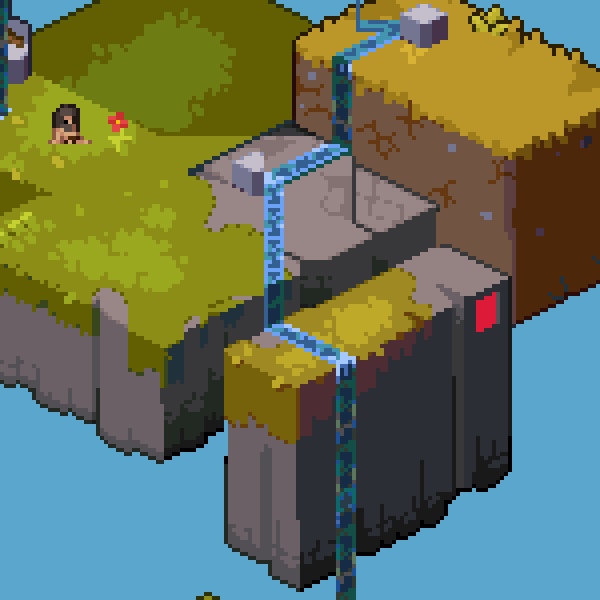
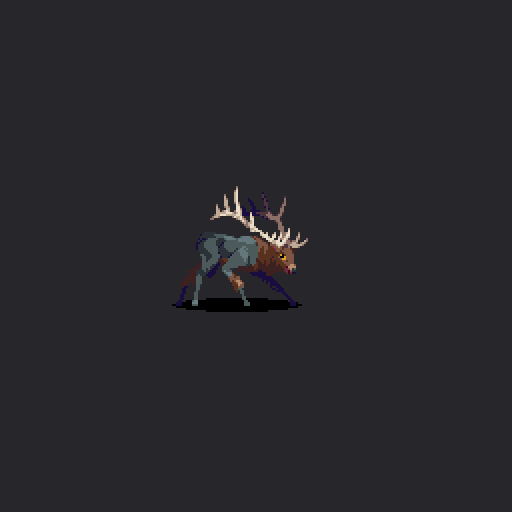
Most pixel art games are fully 2D, or use 3D with a pixel shader bolted on. Smartest Whale does something different. The world is fully 3D with physics, destructible buildings, and procedurally generated maps. The characters and NPCs are sprites. Both are filtered through a custom pixel pipeline built in Unreal, so they share the same look without being the same thing.
Resolution control
Unreal renders has a complex built in render pipeline by default. Getting a genuine low-res pixel look meant down scaling that without sacrificing performance
Sprite consistency
Sprites and 3D geometry needed to feel like they belonged in the same world, not like two different art styles sitting next to each other.
Creative flexibility
The pipeline needed to stay flexible so things like depth of field, chromatic aberration, and CRT lines could be added or removed without rebuilding anything.
The Problem
Getting a consistent pixel art look across 3D geometry and 2D sprites in Unreal Engine does not have an out-of-the-box solution. Three things made it tricky.
Procedural maps
No two runs are the same. Reference gathered across farmlands, towns, cities, and sci-fi environments to give each area a distinct feel rather than just a different skin.
Gene splicing system
Run-based and permanent unlocks through creature DNA. Electrical eel, octopus arms, volcano snail and more still to design.
The process
The solution was a scene capture component feeding into a low-resolution render target with nearest-neighbour sampling, displayed as a UI widget over the scene. This intercepts the render at the right point, forces the pixel look across everything on screen, and keeps the 3D world underneath fully intact.
With scene depth data accessible in the material, extra effects like depth of field blur, chromatic aberration, and CRT scanlines all become toggleable rather than baked in. The pixel look is consistent across sprites and 3D geometry because they are both going through the same pixel perfect filter.
Building destruction follows the same logic. Destroy the bottom floors and everything above drops straight down on the grid. Real physics would have buildings lean and crumble, which looks more realistic but feels wrong for this kind of game. The grid drop is more satisfying and follows that 8 bit feeling.
The rest of the process has been exploratory. Ideas are tested within the whole of the project, farmers with pitchforks, mob AI, the foetus life system, then only fully implemented if they add to the overall experience in a meaningful way. Some things are cool in theory but do not work in practice. Emergent gameplay and the synergy of abilities and mechanic especially in a rogue-like game cannot be forced and only comes with discovery.
Where it is now
Playable, with a lot still to build
Procedural map generation, player movement, building destruction, NPC pathfinding, melee, and the blood meter and life system are all in and working. The gene splicing power-up system is next, and that is the part where the game design gets interesting.